SMART goals template
Use SMART goals to establish objectives for your product or team
Use template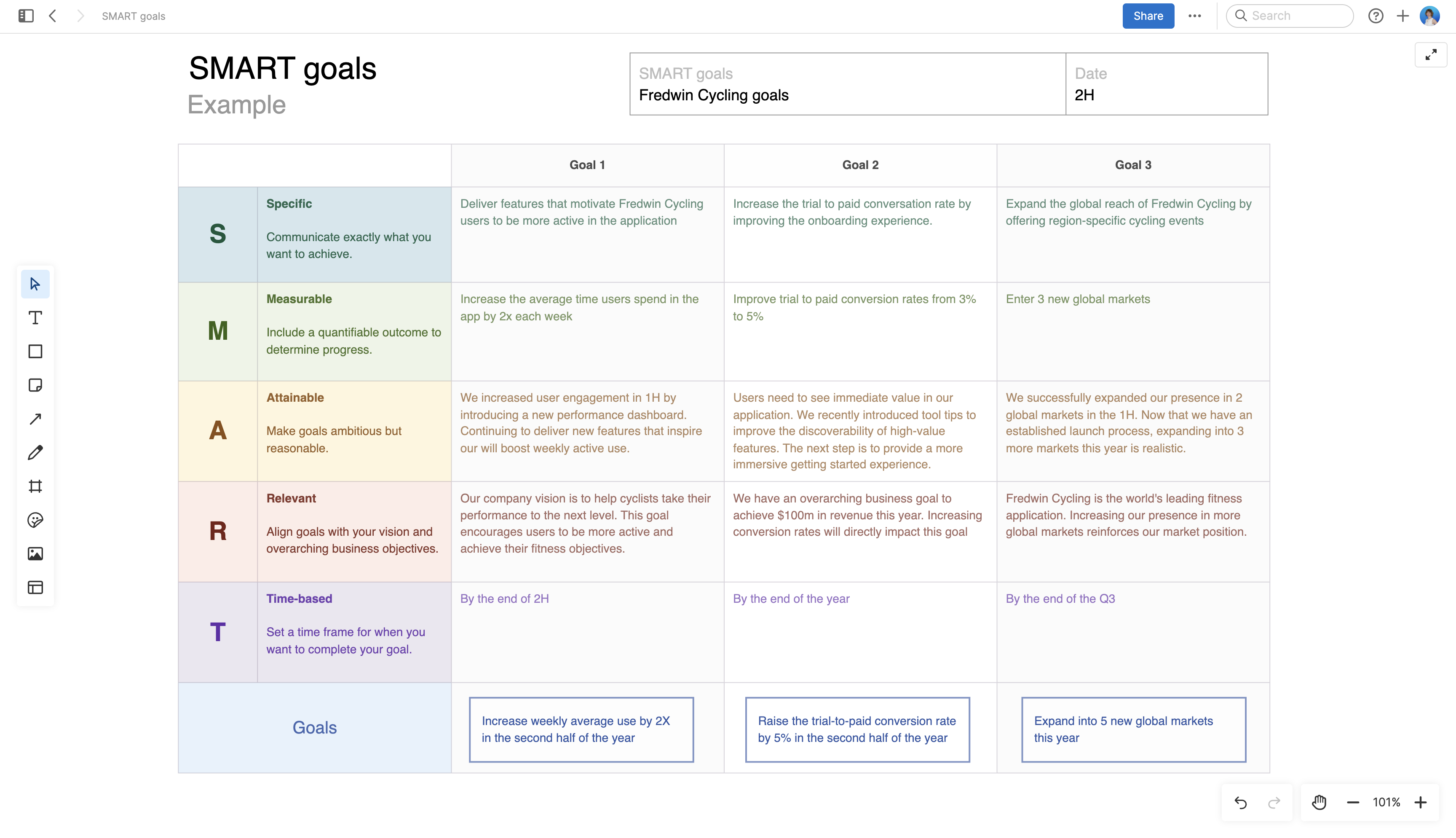
About the SMART goals template
People who set goals get more done — at least, that is the assumption. But you have to be smart about the goals you set. And it is not really about getting more done — it is about getting the right things done.
SMART goals can help you focus on the right things. They give you a framework for setting team and product goals that are specific, measurable, attainable, relevant, and time-based. The idea is that applying well-defined, concrete criteria enhances the team's focus, accountability, and likelihood of achieving the goals.
Use this template to build and share SMART goals. When everyone knows what they aim to achieve, they can make better choices about what to work on now versus later.
Best practices
Set meaningful objectives and bring more clarity and focus to your team.
Define your goals Each goal should focus on one thing only — using clear, precise language. Use action-oriented verbs to describe what needs to be done.
Quantify success Specify how you will track and measure progress towards goals. Include a quantifiable metric — such as a numerical value or percentage — so you will know when a goal has been achieved.
Consider the broader impact Make sure each goal is realistic — considering available resources, time, and other constraints — and that each aligns with your overarching business objectives.
Formalize your strategy Include a time frame for achieving each goal and write a concise statement summarizing what you want to accomplish. Convert directly into goals in Aha! Roadmaps to codify your objectives.
FAQs about the SMART goals template
What makes a goal SMART?
A SMART goal meets five criteria at once. It is specific about the outcome, measurable with a number or percentage, attainable given your resources, relevant to a current business priority, and tied to a date. In practice, the specific and measurable parts are what separate a SMART goal from a good intention — and they are the two most teams skip when they are moving fast. Here is a useful test: If two people could read the goal and disagree about whether it was met, it is not specific enough yet.
How many SMART goals should a team set at once?
Three to five SMART goals per quarter or half year works for most product teams. That is enough to cover your real priorities without spreading attention so thin that nothing meaningfully progresses. Remember that every goal you add competes for the same PM, engineering, and design capacity. When a list runs past five or six, some of those goals are usually projects or tasks in disguise, or the team has not yet decided what comes first.
How often should you revisit SMART goals?
Check progress on the same cadence you run planning — typically every sprint, month, or quarter. The time-bound criterion only works if the date stays fixed; moving deadlines to stay "on track" is how a goal loses its meaning. If a goal is clearly off, it is more honest to mark it missed and ask why than to adjust the target.
What is the difference between SMART goals, OKRs, and KPIs?
SMART goals, OKRs, and KPIs answer three different questions. A SMART goal defines a single, time-bound outcome and how you will measure it; an OKR pairs an ambitious objective with a few key results and is usually meant to stretch past what feels comfortable; a KPI is an ongoing health metric you watch continuously, not a goal you complete. Many teams use all three — KPIs to monitor the baseline, OKRs to set quarterly direction, and SMART goals to make individual commitments concrete enough to track. This template focuses on the last of those.
Is this template free to use?
Yes. To use this SMART goals template, sign up for a free 30-day trial of Aha! Whiteboards. (You can also try this template in Aha! Roadmaps if you need a complete product management solution.) Easily customize the template to suit your needs, then share it with as many people as you want (for free) to streamline collaboration.