Top
What types of organizations practice PI planning?
PI planning is part of the SAFe methodology and a required practice for anyone who follows the framework. But these events can be most effective for large enterprise organizations with heightened standards or complexity in the development process. For example:
Companies in industries that must adhere to strict product regulations (such as finance or healthcare technology). A more comprehensive and prescriptive process can reduce risk.
Companies with multidisciplinary products (e.g., software with a hardware component) that might involve manufacturing and supply chain considerations in addition to software development. A standardized approach can bring together these different forms of delivery.
PI planning is also practiced by teams that are not SAFe purists, but do cherry-pick elements to incorporate without committing to the whole framework. You might call this Essential SAFe (or simply being SAFe-ish). It can be helpful for planning near-term agile development work at scale, even if you are not interested in adopting the entire methodology. This is something to keep in mind if SAFe as a whole feels too overbearing.
Our own approach at Aha! incorporates strategic planning sessions and stakeholder syncs that some might consider similar to PI planning. For instance, leaders across the organization get together at fixed planning periods with more flexible work cycles or sprints in between. We call our approach The Aha! Framework.
Related:
Top
Why do organizations carry out PI planning?
A PI plan includes work for many agile teams across several weeks. All of these tasks must be in line with overall business, product, and team goals. Everything also has to fit within the teams' capacity, and engineers must feel confident that they can commit to and complete the plan before moving forward.
That is a lot. So it makes sense that building a PI plan takes serious effort. Organizations host PI planning events to ensure everyone has a recurring and dedicated time to get this done — with the benefit of a structured agenda and set schedule. But there are other reasons why this practice is important. Many businesses see a number of benefits from PI planning, such as the following:
Drives alignments to a shared mission and vision
Encourages a goal-first mindset
Builds relationships across teams and with leadership
Fosters cross-functional collaboration and communication
Builds transparency around priorities and capacity
Helps in adapting to changes and ensuring continuous value delivery
Top
Who is involved in PI planning events?
The unwritten SAFe "rule" is that the people who do the work plan the work.
- Scaled Agile Inc.
PI planning is a major cross-functional effort involving everyone from business leadership to product managers and system architects. All of these groups work together to offer various context and direction on the plans.
But at the core of PI planning is the agile release train (ART). In SAFe, an ART is a group of agile teams — it includes all of the scrum masters, product owners, and developers from each team whose work will be defined in the upcoming PI. Because these are the people who will do the work, they play a large part in drafting the overall PI plan.
The table below provides a brief overview of who attends PI planning events and what they contribute:
Role | PI planning responsibilities |
ART | Give input to help shape PI objectives Provide feedback on feature priorities Draft the PI plan Agree and commit to upcoming work
|
Release train engineer (RTE) | Prepare content and context for PI planning sessions Facilitate the event schedule and introduce speakers Manage meeting logistics and tooling (such as videoconferencing and whiteboard software)
|
Product managers | Present the product vision, roadmap, and highest-priority features in the backlog Offer input on customer needs Help define PI objectives Update the roadmap to reflect new PI plans
Read more about the role of product managers in SAFe. |
System architect/engineer | |
Business owners | Provide business context and present strategy Actively engage in plan drafts and reviews Validate that PI objectives support business goals
|
Note that if your organization does not have dedicated SAFe roles (such as an RTE), these responsibilities will likely be handled by a project manager or program manager.
Top
How does PI planning work?
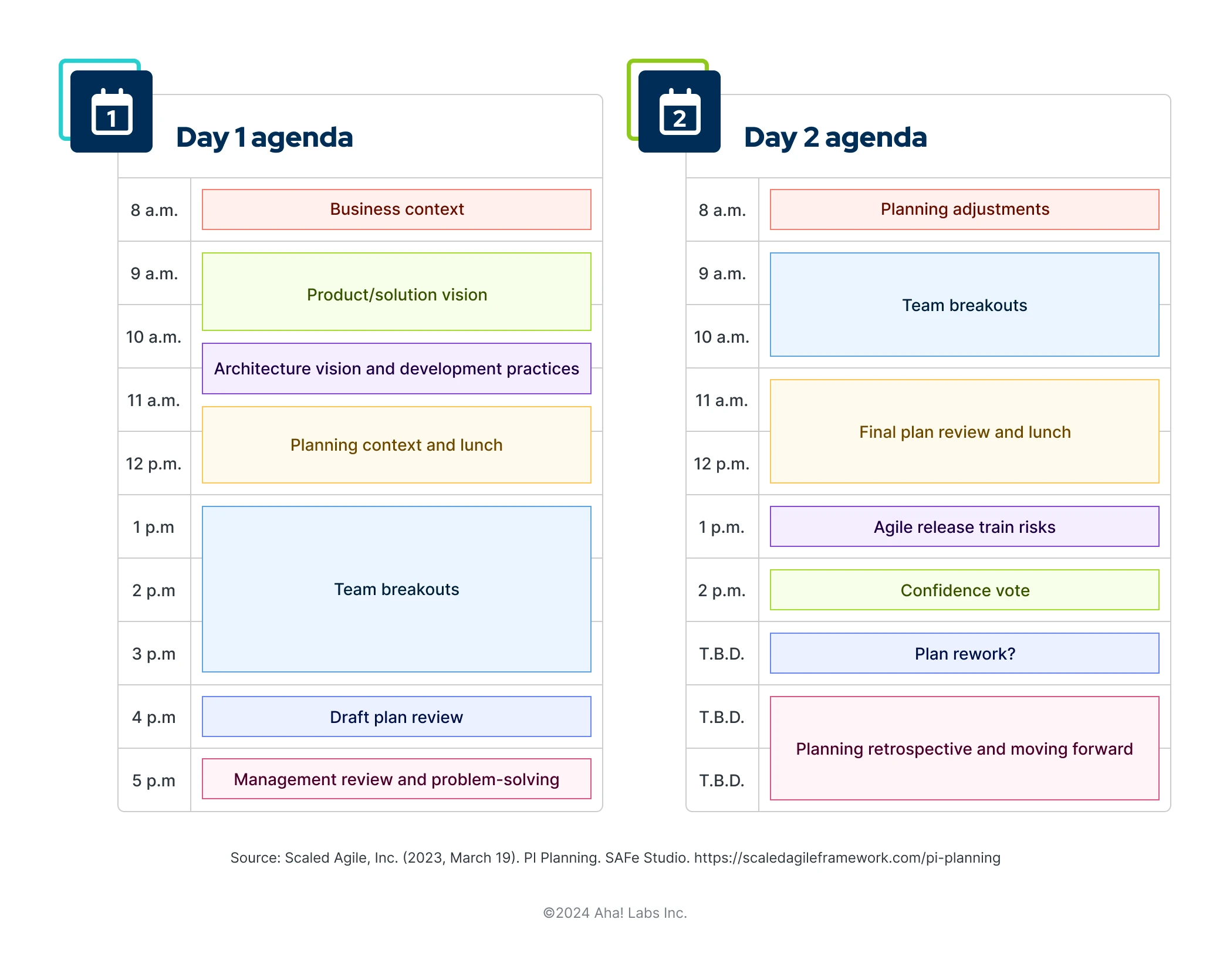
What really goes on during PI planning? In brief, participants meet over one or two days to get aligned, draft the PI plan, review it, and commit to it — just like you see in the sample agenda above.
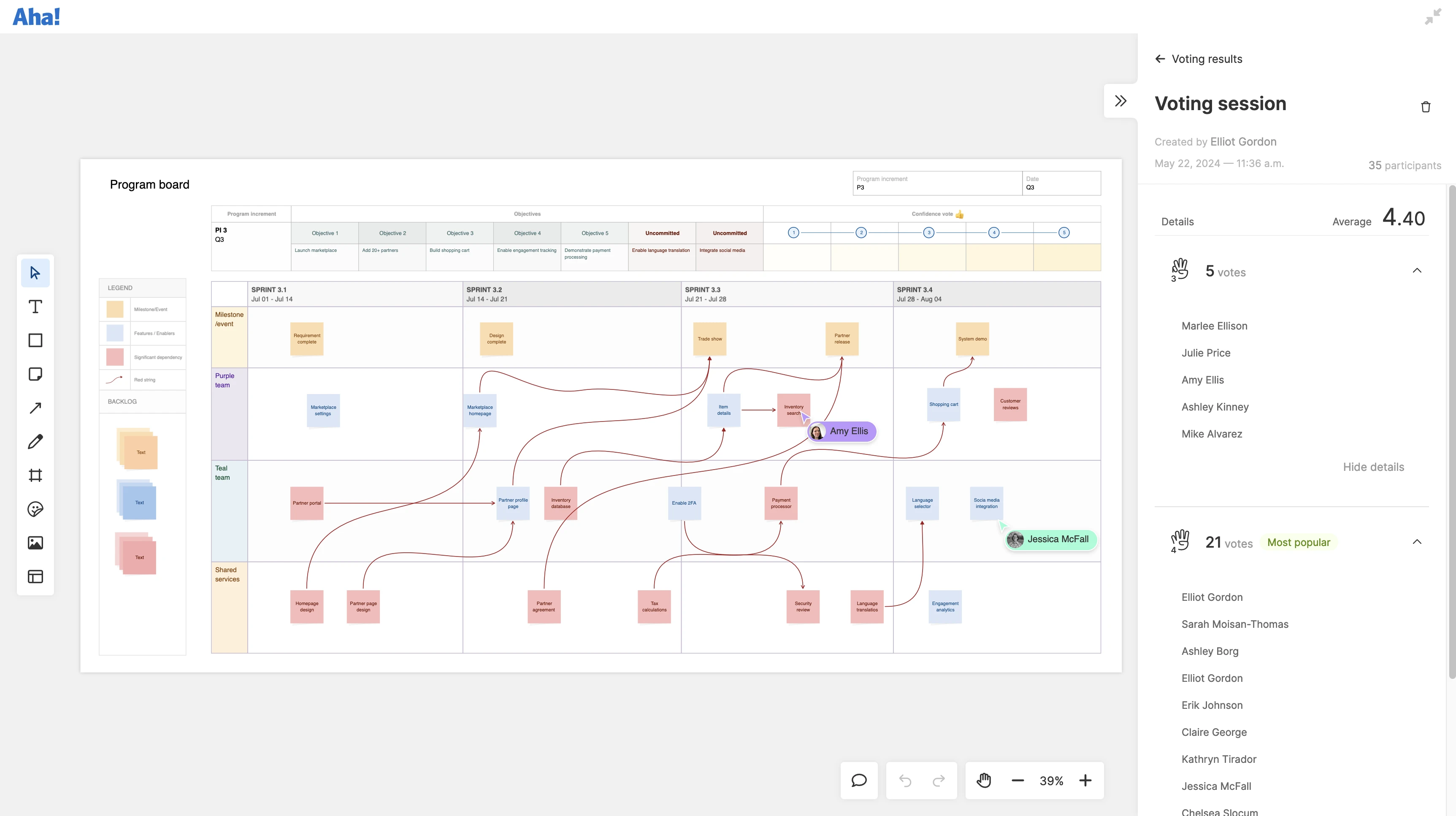
This starts with business and product leaders providing context on current goals and priorities via presentations. From there, agile teams break out to begin drafting the PI's objectives and overall plan, pulling prioritized features into sprints (or iterations) for each group on the program board.
The PI plan goes through multiple rounds of review, and participants make adjustments to accommodate any constraints, dependencies, or critical feedback. The team then holds a confidence vote to ensure there is alignment and support for the plan. Finally, everyone engages in a retrospective to reflect on the planning process. By the end of any PI planning event, everyone involved should be clear on priorities and work to be done for the near future. In short, they are fully prepared to get started and confident that goals can be achieved.
That is a condensed explanation. But it should give you the gist. Remember that your PI objectives and a complete program board are the key outputs to achieve — the number of hours you spend and the exact structure of each session can be adjusted to what is best for your team. For more details, check out the related articles below.
Related:
Top
SAFe® PI planning whiteboard templates
Whether you do PI planning remotely or in person, these events always involve visual components. This helps everyone engage with the in-progress plans and see how everything fits together.
Some teams use PI planning applications, project management software, or Excel to capture their plans. But SAFe is complicated enough as it is — why not make this part a little easier? Although these events involve many stakeholders and decisions, something as simple as an online whiteboard can be a great tool for collaborative PI planning.
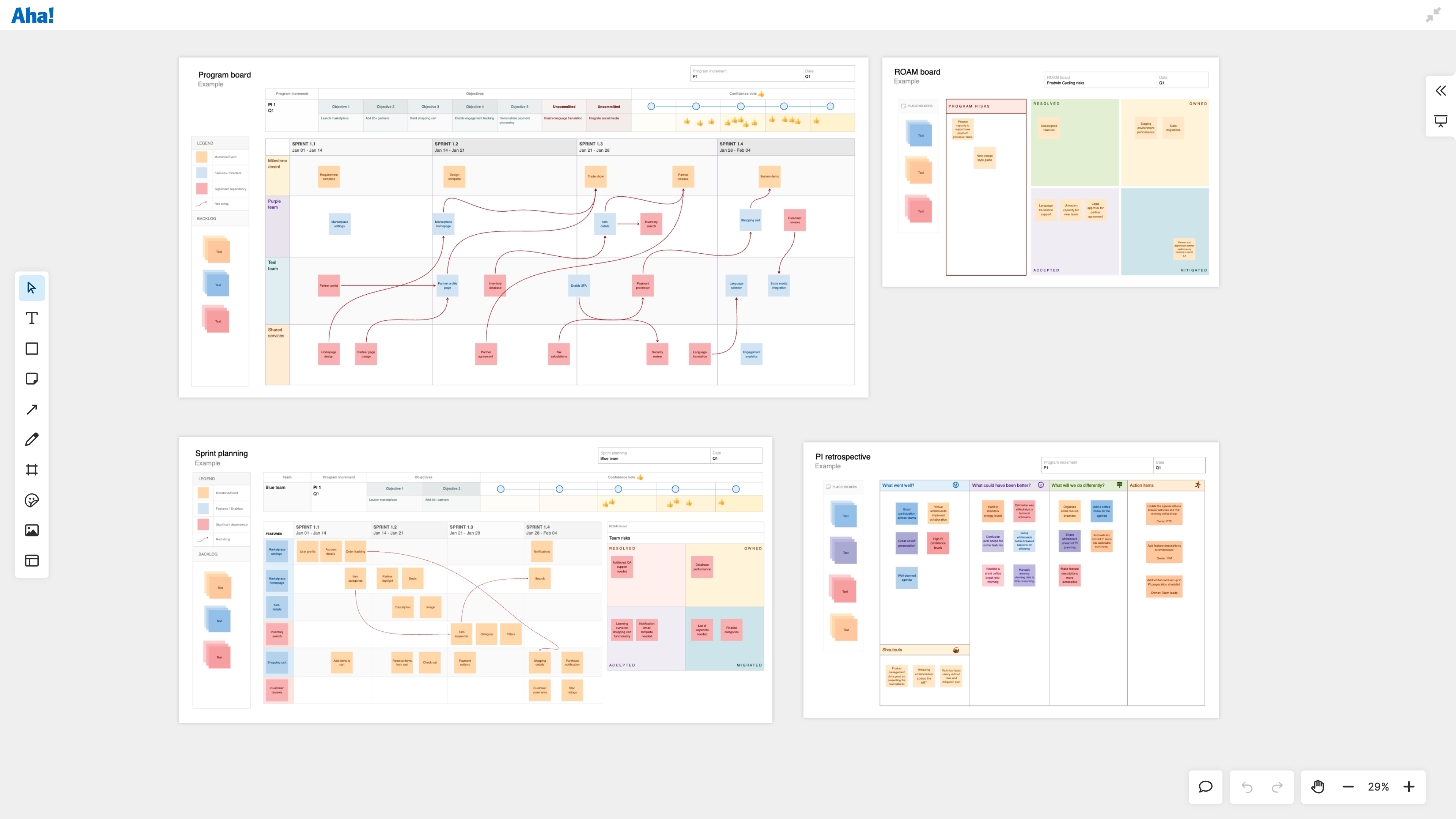
If you want to give this a try, we put together a collection of SAFe PI planning whiteboard templates to get you started in Aha! software. It includes these materials:
Program board: Capture PI objectives, backlog, dependencies, and other inputs across sprints.
ROAM board: Identify and categorize risks during PI plan reviews.
Sprint planning: Create a high-level sprint plan for each team within the ART.
PI retrospective: Reflect on what went well and what could be improved for the next PI planning event.
Our built-in fist to five confidence voting tool