How does Aha! Builder compare to Lovable? Explore what to look for in an AI app builder for your product team.
Aha! Builder vs. Lovable: How to choose the best AI app-building software


AI app builders are quickly becoming essential to any product team's tool kit. The ability to build AI prototypes and applications in minutes is changing how teams design, test, and deliver software — and product managers who hone this capability now will be far better prepared to lead in the AI era.
As a result, many AI app builders are available on the market. Two popular options are Aha! Builder and Lovable. Let's compare both tools directly, covering key features and differences so you can decide which AI app builder is most aligned with the way your team works.
About Aha! Builder
Aha! Builder is an AI app builder that gives product teams a trusted, organized way to build and deliver business applications. It helps you rapidly create prototypes, validate proofs of concept, and build secure applications without technical expertise. Everything you create is informed by product strategy and customer needs and built to meet enterprise security and governance standards.
Aha! was founded in 2013. We provide an integrated product management software suite that includes Aha! Roadmaps, Aha! Discovery, Aha! Ideas, Aha! Whiteboards, Aha! Builder, Aha! Develop, Aha! Teamwork, and Aha! Knowledge. Embedded in all of Aha! software is Elle, a purpose-built AI assistant.
About Lovable
Lovable is an AI app builder for people who want to quickly turn an idea into a working website, prototype, or application. It is designed for general-purpose use and works well for individuals and teams that do not need a formal product planning process or strict governance and operating standards.
Aha! Builder vs. Lovable feature comparison
Capability | Aha! Builder | Lovable |
Product strategy and planning | Includes built-in vision, goals, personas, and feature prioritization to guide what Elle builds | Includes app planning and generation workflows; does not include native product strategy tools |
AI capabilities | Elle is purpose-built for product management and can quickly generate and iterate on prototypes, proofs of concept, and applications informed by strategy and other product context | AI capabilities are general-purpose and focused on generating and iterating on prototypes and applications from prompts |
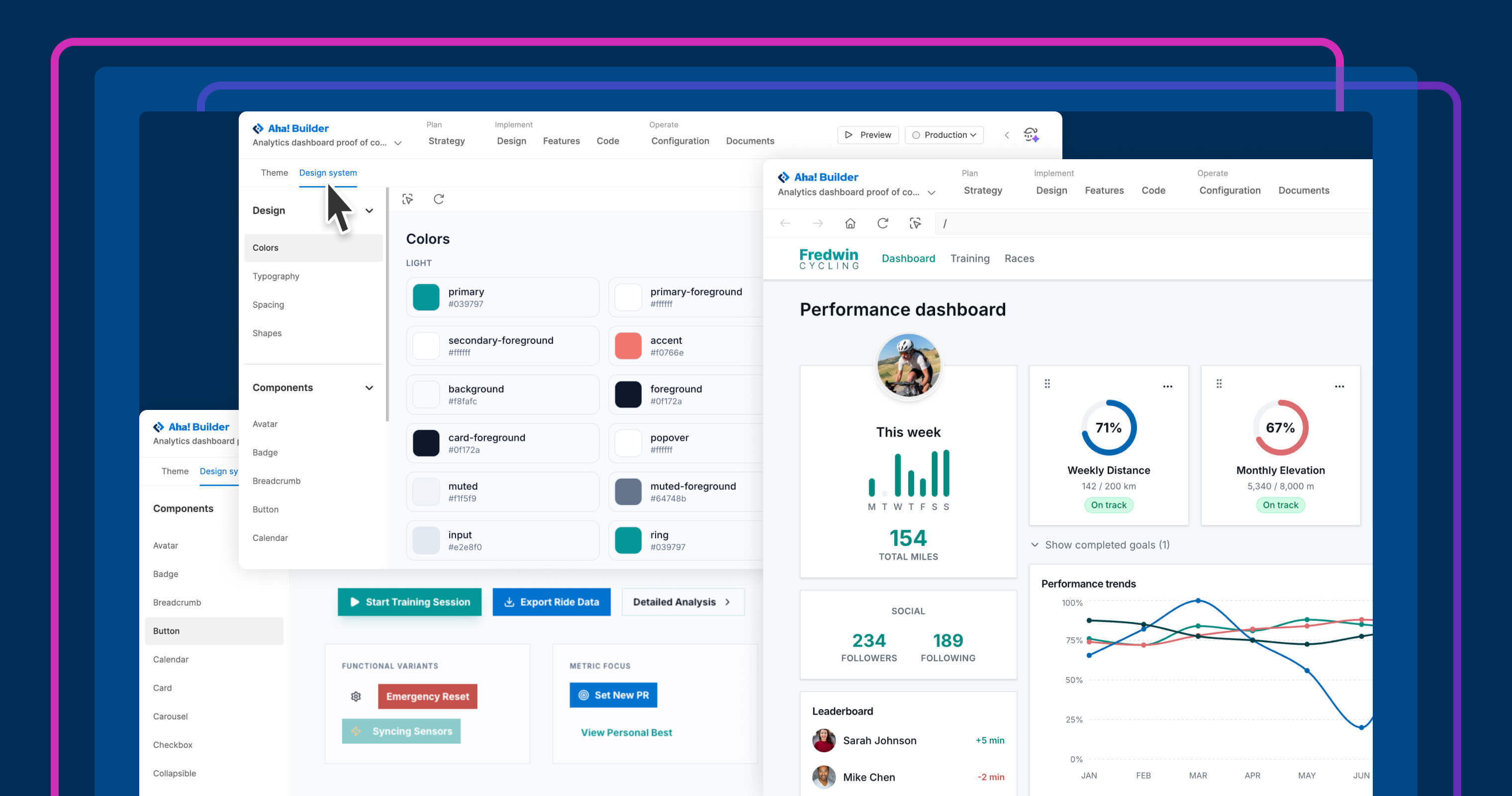
Design system support | Supports creating a shared design system from screenshots, design files, or text prompts, with controls for colors, typography, layouts, shapes, and components | Supports reusable design components, a visual editor, and design previews |
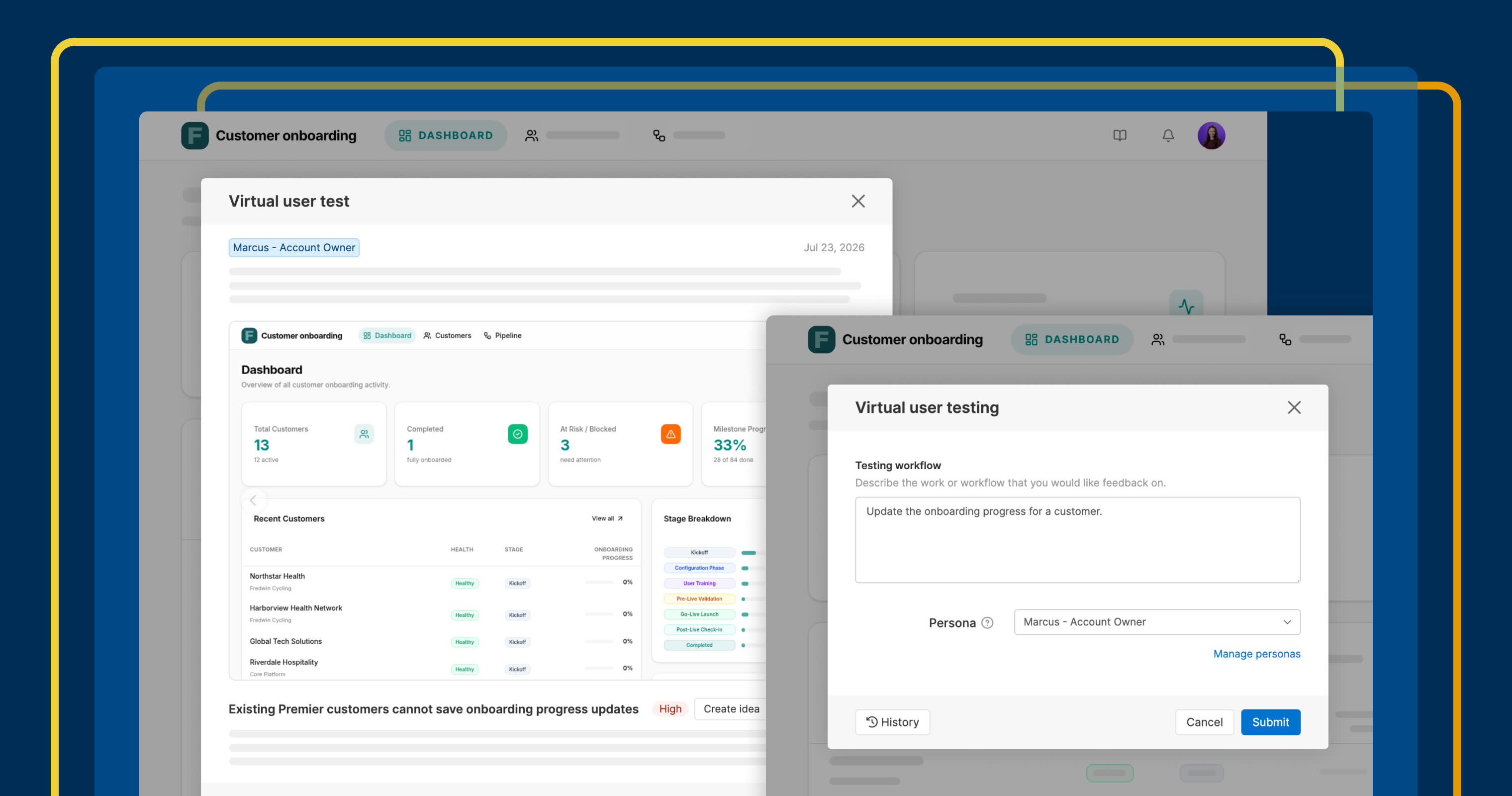
Customer feedback management | Includes in-app feedback widgets for prototypes and applications and a feedback page to prioritize ideas | Does not include built-in feedback collection or idea management |
Application infrastructure | Includes a built-in database, user authentication, managed hosting, secrets management, email delivery, and custom CNAME and subdomain support | Includes database, authentication, storage, edge functions, custom domains, connector integrations, plus GitHub syncing and exportable code |
Governance and compliance | Adds governance workflows on top of secure hosted infrastructure, including rule templates, approval workflows, application monitoring, security/privacy reviews, and exportable compliance reports | Includes security scanning and a certified platform, but does not provide built-in privacy assessments, compliance reports, governance templates, or deployment approval workflows |
Team collaboration | Supports shared workspaces, user permissions, stakeholder review workflows, and collaboration across the application development lifecycle | Supports collaborative editing, but offers fewer built-in workflows for structured team review |
Application portfolio management | Gives teams a scalable, centralized view of applications across the portfolio with status tracking, permissions, and approval workflows | Does not include portfolio-level application management |
Documentation generation | Generates application user guides automatically with Elle, including screenshots and in-app publishing | Does not include built-in documentation generation; separate tools are required |
Product management integration | Includes a native Aha! Roadmaps integration so teams can turn roadmap records into prototypes and applications in Aha! Builder, with Elle using product context from Aha! Roadmaps to help guide what gets built | Integrates with tools such as Linear, Jira, Notion, and Confluence; does not include a native product management software connection |
Prototype-to-production workflow | Designed to support the full AI app lifecycle from planning through production with governance and ongoing management | Designed to generate and iterate on applications; centered on deployment infrastructure rather than product management needs |
Support | Includes support from product management experts with all plan tiers | Offers community and email support, with priority support on higher plan tiers; support model is not centered on product management expertise |
Create trusted AI prototypes and apps. Try Aha! Builder
Key differences between Aha! Builder and Lovable
🏗️ Product management-focused AI app builder
Aha! Builder combines the speed and structure that product teams rely on, with product development knowledge built into Elle and the app-building workflow. Lovable takes a different approach. It is designed for broader use — equally useful to a founder, marketer, or developer with an idea to test. That flexibility makes Lovable suited to general-purpose experimentation and output. But it also means it was not built specifically with product management practices in mind.
🎯 Strategy and planning before AI app building
Aha! Builder starts with strategy. Alongside prompts, Elle draws on product goals, personas, and other context to clarify who the app is for and what problem it should solve before building. Aha! Builder also includes feature prioritization so product managers can bring feedback and strategy into ongoing AI app improvements. Lovable starts with the prompt itself, which suits teams that want to move straight from idea to output without tying the work to product strategy or long-term planning.
🔒 Enterprise governance and security for AI apps
Both platforms run on secure infrastructure, but Aha! Builder is designed for organizations that need governance over what gets built and how AI apps are reviewed, approved, and deployed. It includes centralized controls, privacy and security reviews, compliance reporting, rule templates, and deployment approval workflows as part of the core product. Lovable offers less built-in support for organizational oversight, with select governance features offered as a separately priced upgrade.
🗄️ AI application and portfolio management
Aha! Builder is designed to support teams as AI app development scales across an organization. Instead of treating each prototype or app as a separate effort, it gives teams a shared way to manage who can build, edit, and deploy, along with a central view of every app and its status. Lovable is more centered on building one application at a time, which can work well for individual projects but offers less support for managing an AI app portfolio.
🔗 Connected workflow for AI app development
Aha! Builder takes a connected approach to AI app development. Product strategy, customer feedback, building, documentation, and delivery stay tied together in one system — so teams can move from planning to a deployed application without losing context. The native connection to Aha! Roadmaps reinforces that continuity. Lovable is more centered on the build step, so teams rely on integrations and separate tools to connect the rest of the workflow.
Aha! Builder vs. Lovable: Which AI app builder is right for your product team?
Choose Aha! Builder if ...
You want a trusted, organized way to build prototypes, proofs of concept, and business applications with AI.
You want strategy and customer feedback to shape what gets built before you prompt.
You need governance built in — including privacy reviews, compliance reporting, and approval workflows.
You plan to scale AI app development across your organization and need centralized visibility and control.
You want planning, feedback, building, documentation, and delivery to stay connected in one system.
Choose Lovable if ...
You want a general-purpose AI app builder, not one built around product management processes.
You prefer to build directly from a prompt without a strategy or planning step first.
You do not need enterprise governance policies or structured approval steps built in.
You are focused on building individual applications, without a need for portfolio-level standards across apps.
You are willing to use separate tools and integrations for planning, feedback, and documentation.
Aha! Builder vs. Lovable pricing
Aha! Builder offers more predictable pricing for enterprise teams that want to plan costs upfront. Lovable pricing can start at a lower entry point but may lead to more variable costs as usage grows.
Pricing factor | Aha! Builder | Lovable |
Starting price | Limited free tier available; paid plans start at $25 / month | |
Pricing model | User-based and tiered; fixed pricing for additional users, AI credit pools, and deployed applications | Credit-based and tiered; consumption-based pricing for AI usage and deployed application hosting |
Hosting | One deployed application included per account; additional deployed applications are available for a fixed add-on fee | Hosting is usage-based; small apps are often covered by the included monthly allowance, but higher usage incurs additional variable costs |
Cost predictability | More predictable; pricing follows set tiers, with fixed costs for additional AI credits and deployed applications | Less predictable; total costs vary based on AI usage and deployed application infrastructure, including compute, storage, bandwidth, and databases |
Aha! Builder user reviews
"Aha! Builder delivered a true end-to-end build and deployment experience — enabling me, as a product leader, and my team to create and launch real applications without relying on engineering or IT." Senior Director, Product Management Mid-market (51-1,000 employees)
"Someone with a relatively low level of software development knowledge could design, iterate, debug, and ship a professional application to production." Verified user in airlines/aviation Mid-market (51-1,000 employees)
"I appreciate that [Aha! Builder] is built with enterprise use in mind. Features like centralized governance, privacy and security reviews, authentication options, and feedback collection make it more practical for teams that need structure, oversight, and IT alignment." Verified user in banking Enterprise (>1,000 employees)
Create trusted software with the AI app builder for product managers. Try Aha! Builder now
FAQs about Aha! Builder and Lovable
What is the difference between Aha! Builder and Lovable?
Aha! Builder and Lovable are both AI app builders, but they support different ways of working. Aha! Builder gives teams a trusted, organized way to plan, build, and manage business applications, with strategy, feedback, documentation, and delivery connected in one workflow. Lovable is more centered on moving quickly from prompt to application, which can work well for individuals and small teams but offers less built-in support for governance, portfolio management, and end-to-end product workflows.
Is Aha! Builder or Lovable better for product managers?
Aha! Builder is generally better for product managers because it is purpose-built for this work. It connects strategy, customer feedback, prioritization, and documentation to the AI prototyping and application development process — helping product managers guide what gets built and how it evolves over time. Lovable can be used to create software prototypes and full applications, but it is not built specifically for how product managers work.
Does Aha! Builder offer better governance and security than Lovable?
If your team needs built-in governance for AI app development, Aha! Builder offers more complete support. It helps organizations review, approve, deploy, and manage applications within a structured operating model, with privacy and security reviews, compliance reporting, and controlled deployment built into the product. Lovable supports application security and offers some governance features (such as single sign-on and audit logs) as a separately priced upgrade. But it provides less built-in support for ongoing oversight.
Can Aha! Builder replace Lovable for AI prototyping?
Yes. Aha! Builder can replace Lovable for AI prototyping. It supports the same core workflow of turning prompts into interactive prototypes, sharing concepts before development, and iterating quickly. It also gives product teams more context around what they are building, with built-in feedback collection and the ability to generate prototypes from existing records in Aha! product management software.
What happens to my prototypes and apps if I switch from Lovable to Aha! Builder?
You need to rebuild existing prototypes and applications in Aha! Builder. There is currently no direct migration path from Lovable.
However, this can happen quickly. Teams can use screenshots and other reference materials to recreate prototypes with Elle in Aha! Builder without starting from scratch. Once rebuilt, the application lives in a connected environment where planning, feedback, documentation, and ongoing management stay tied to the work.