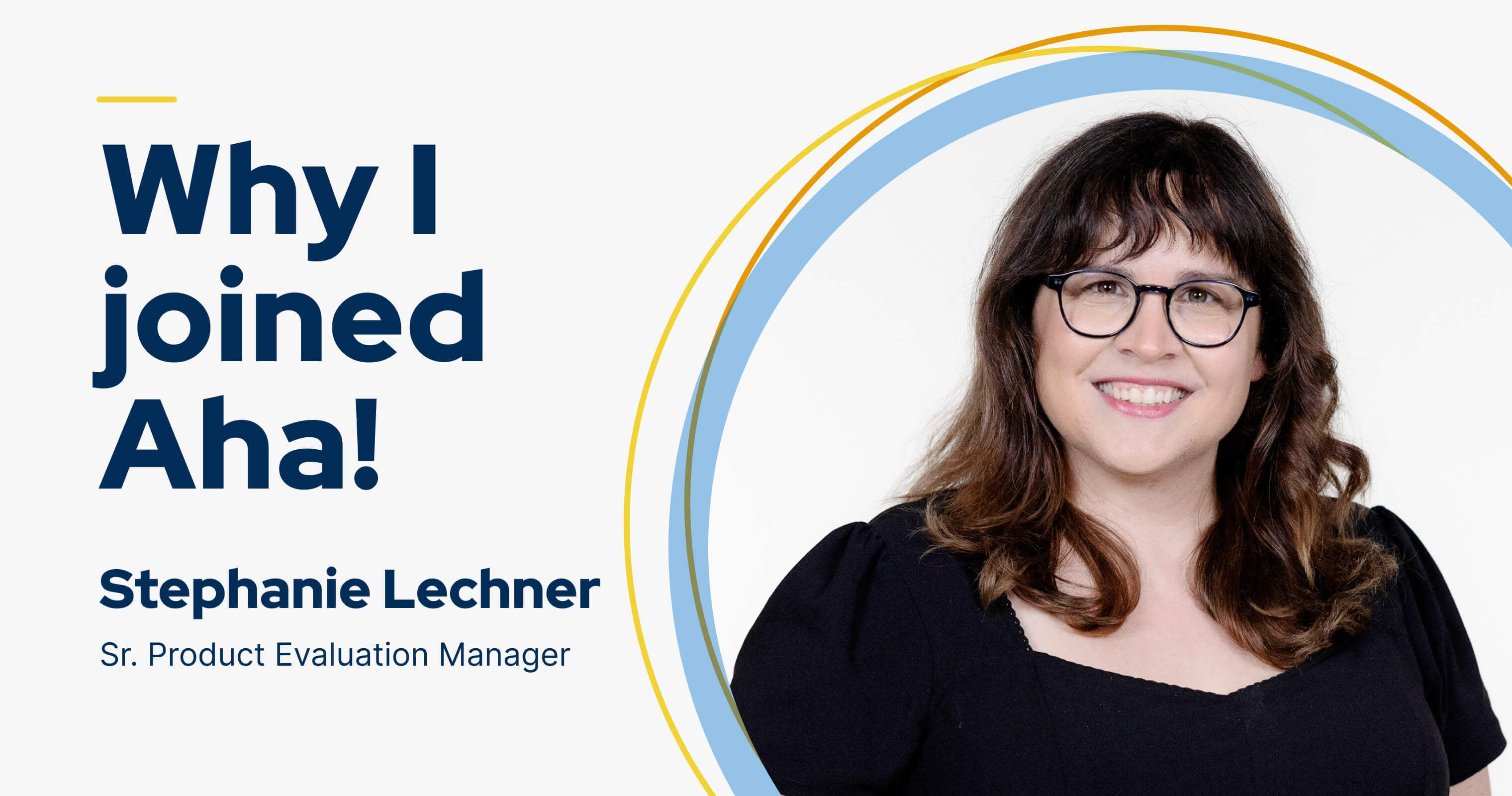
Stephanie is a power user and a problem solver on the Customer Success team. | Photo by Jodi B Photography
My name is Stephanie Lechner — this is why I joined Aha!


A lot of people say they enjoy solving problems. It makes sense. It is a rewarding feeling, no matter what your job is. But I really love to spot problems. I have a knack for it — they seem to jump out at me, whether it is a feature bug, friction in a workflow, or an opportunity for a whole new process or tool. And once I see a problem, I cannot help but try my best to solve it.
What excites me is identifying a need, then figuring out a better solution — whether it takes moments or months to solve.
My introduction to product development was early in my career with J.Crew in New York City. I got to know the retail products (which sometimes felt a little like The Devil Wears Prada) and the software we used to manage inventory across stores. I quickly became a power user of those tools. My teammates often told me I should work in QA because I was so good at finding bugs. But I think I just had an instinct for seeing what needed to improve and finding better ways for us to work.
About three years later, I was ready to leave the city. That led me to a demand planning role with Nike in Denver, then Portland. The company was investing more in online shopping at the time, which aligned with my experience in both retail and digital inventory management. I worked to build deep knowledge of our systems and even created complex spreadsheet tools to help our team handle e-commerce inventory more effectively.
Then an interesting shift happened. The company wanted to move on from spreadsheets and build dedicated planning software, so they pulled me in as a subject matter expert to help define the direction. I wrote requirements, mocked up concepts, and our engineering team built them. I loved to see my ideas come to life. When we brought in some agile consultants to help with this initiative, they pointed out that my work had a formal name (and it officially became my title).
I became a product manager almost by accident. But the work I had been doing all along — finding problems, shaping solutions, and working with the team to make them real — was what it meant to be a PM.
After more than seven years with Nike, I was ready for something new. I joined a logistics startup in Los Angeles as their first product manager outside of leadership. We helped growing brands connect their e-commerce storefronts to warehousing and manage orders more smoothly. It was exciting to build solutions that helped those small businesses scale. But I soon realized that early-stage startup life was not for me, so I started looking to join a more established company again.
I saw Aha! was hiring for Customer Success roles that required product management experience and was immediately intrigued. I pushed during the interview process to understand what the day-to-day work really looked like. It felt aligned with what I enjoyed most about being a product manager — but instead of solving problems for my own team and customers, I would help customers solve theirs. I could use my product experience in a consultative way.
When I joined as a Product Success Manager, I was really able to put my power-user mindset to work. It was satisfying to learn the ins and outs of our software, then use that knowledge to meaningfully help our customers. That meant everything from technical troubleshooting to coaching people on how to use advanced capabilities, like our Jira integration and capacity planning. (And of course, I still loved to spot bugs and report them.)
I am now a Product Evaluation Manager on the team. Instead of supporting customers across a wide range of daily needs, I focus on helping enterprise organizations understand how our software addresses their specific use cases. That means going deep with some of our largest customers — learning how they work, then translating powerful functionality into stories that resonate — so they can picture how it will work for them.
At Aha! I work to deeply understand what customers need from our software. But instead of building it, I get to help customers build confidence in using it.
That connection to storytelling is not a coincidence. Outside of work, I perform as a live storyteller here in Los Angeles. Being on a remote team is an essential part of this. It allows me to do my best, most productive work while being fully present in the city I love and pursuing what brings me joy.
That is why I joined Aha! — and why you should too.